Try the product
The whole interface, with invented data, in its own tab. No sign-up.
Interactive demoThe questions buyers ask before a procurement conversation happens, a plain-English glossary of the terms that appear in primary care contracts, and a product you can try without talking to anyone.
The whole interface, with invented data, in its own tab. No sign-up.
Interactive demoData handling, tenant separation, audit, retention and model usage, for a DPIA.
Read the detailPer-practice pricing, PCN rates, and a twelve-week paid pilot.
See pricingAnswered from what the software does, not from what would sell well.
No. It has no connection to EMIS, SystmOne or any clinical system, and no integration is planned that would give it one. It reads the documents you upload and nothing else.
No — and it tries not to let you. Every upload is scanned before it is processed, and one that appears to contain patient-identifiable data is rejected with the reason, rather than quietly accepted. Contracts and service specifications do not contain patient data, so this should never fire in normal use.
No. Your documents are sent to the model that reads them and are not used as training data by us or by the model provider.
Every extracted item carries a citation to the passage it came from, and the interface shows you that passage. An item the system cannot trace back to the document is discarded rather than displayed — the database will not store one without a source. Answers to questions are drawn from the approved documents and quote them.
Upload the new version against the same document. Previous versions stay readable, and each extraction stays attached to the version it was actually made from, so an item approved last year does not silently start claiming to describe this year's contract.
Separate organisations cannot see each other's documents at all — that is enforced in the database rather than in application code, so a query that forgot to filter would still return nothing. Within one organisation, staff share the document library, and what differs is what each role may do: extract, draft communications, approve translations, manage settings.
Yes. Eight roles, each with its own combination of four rights, enforced on the server rather than by hiding buttons. A receptionist can read the answers and cannot start an extraction or approve a communication.
PDFs, up to 32MB each. A scanned PDF with no text layer is detected and reported rather than silently producing nothing.
No. It drafts communications for a named person to approve, and there is no send route and no messaging gateway in the product — approved text leaves as an export, and whatever you already use to contact patients sends it.
A translation has to be approved by someone with the right to approve it before it can be used, and the approval is recorded against their name. Independent linguistic review by a qualified translator is available as a paid service where a communication warrants it.
Yes to both. Extracted items export to CSV, and deleting a document removes every version, its extractions and the stored files — which is what makes an erasure request actually erase something.
Ask us and we will answer precisely, in writing, for the arrangement you would actually be on. We would rather tell you than publish something that stops being true when the infrastructure changes.
Definitions, for someone new to primary care contracting or explaining it to a colleague.
These are general explanations of what the terms mean, not guidance on what any scheme currently requires or pays. Requirements change, and the specification your organisation holds is always the authority.
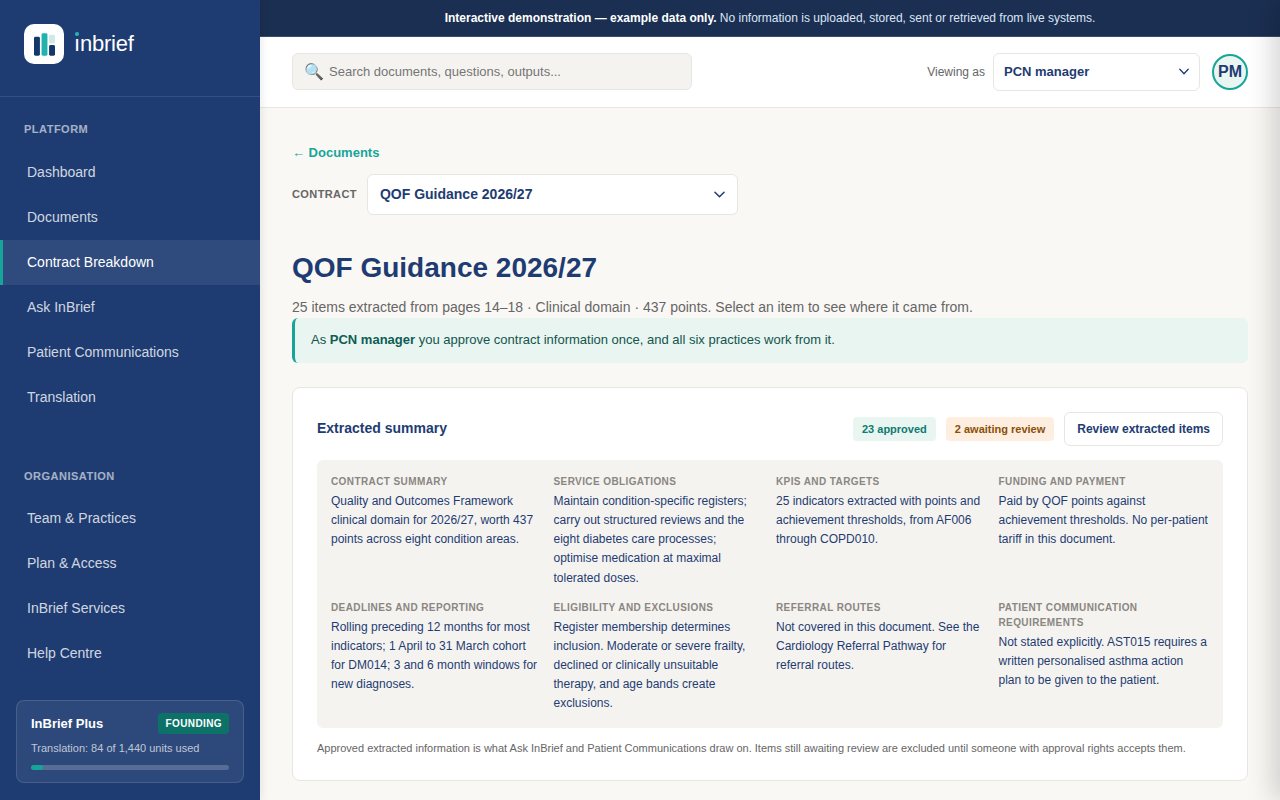
The whole interface, at full size, in its own tab. Look through a contract breakdown, ask a question, draft a patient letter and translate one. No account, no sign-up, nothing to install.
Open the interactive demo (opens in a new tab)No information is uploaded, stored, sent or retrieved from live systems in the demonstration. The practices and contracts in it are invented.